I have modified the Microsoft Template, and you can find a copy of my upgrade template here: http://sdrv.ms/VqNni7
Sunday, October 21, 2012


Saturday, October 20, 2012
Getting Your SharePoint Farm Information
As we prepare our upgrade strategy for SharePoint Server 2013, one of the major requirements is documentation of our existing SharePoint 2010 environment. This is also a good script to run when first getting your hands on an unknown farm. This should save you a bunch of documentation time.
<Lecture>
In theory, you should be reviewing the output documentation of your environment on a weekly basis. You could even go as far as importing the results into SQL, and tracking your growth and changes of your SharePoint Farm with SSRS.
</Lecture>
This script will create a folder, go through your farm, and create the appropriate .csv file as long as you have the appropriate permissions to run the script and you have permissions to access the data.
There are several blog posts on how to take all the .csv files and merge them into one .xlsx file. Here are a couple that I found useful. You will notice that they call the ComObject Excel.Application, so if you do not have Excel installed or the appropriate Office System Driver Connectivity Components installed, you will get an error.
<Lecture>
In theory, you should be reviewing the output documentation of your environment on a weekly basis. You could even go as far as importing the results into SQL, and tracking your growth and changes of your SharePoint Farm with SSRS.
</Lecture>
This script will create a folder, go through your farm, and create the appropriate .csv file as long as you have the appropriate permissions to run the script and you have permissions to access the data.
There are several blog posts on how to take all the .csv files and merge them into one .xlsx file. Here are a couple that I found useful. You will notice that they call the ComObject Excel.Application, so if you do not have Excel installed or the appropriate Office System Driver Connectivity Components installed, you will get an error.
This post by Jeff Hicks was very informational about how to get everything working:
This page actually has a .ps1 for you to download, but in the Q&A section, imfrancisd has a script that works very nicely as well.
Update (01/10/2012)
Added -Limit All
Update (10/30/2014)
Added a check to see if Backup location ends with "\"
Added URL to Sandbox Solution location for output
Added site structure output for entire farm
Added Disposal of objects
Update (10/21/2015)
Moved Script to Gist
Fixed error in Get Features section thanks to Matthew Bramer (@ionline247)
Cleaned up Get Site Structure section to get ALL webs within each Site Collection by Web Application.
Update (01/10/2012)
Added -Limit All
Update (10/30/2014)
Added a check to see if Backup location ends with "\"
Added URL to Sandbox Solution location for output
Added site structure output for entire farm
Added Disposal of objects
Update (10/21/2015)
Moved Script to Gist
Fixed error in Get Features section thanks to Matthew Bramer (@ionline247)
Cleaned up Get Site Structure section to get ALL webs within each Site Collection by Web Application.
Monday, October 1, 2012
SPSRED: Upgrading your SharePoint and SQL Environments
I was fortunate enough to have scheduled the end of a client engagement to coincide with the start of SharePoint Saturday Redmond. When I had submitted the topic, I was kind of hoping to not have it selected, as there was a lot of work that would need to be done. That being said, here is my presentation:
Here is the farm layout:
Here is the template that I used when creating SQL Cluster and HA Group:
Here is the output file from the Test-SPContentDatabase:
All files are located here:
https://skydrive.live.com/redir?resid=8E55AA8C038225F8!4265
Here is the farm layout:
Here is the template that I used when creating SQL Cluster and HA Group:
Here is the output file from the Test-SPContentDatabase:
All files are located here:
https://skydrive.live.com/redir?resid=8E55AA8C038225F8!4265
Saturday, August 11, 2012
Windows 8 and The Unsupported Cisco VPN Client
When you spend most of your time doing remote sessions into client environments using the Cisco VPN Client, I found it a bit troubling to find out that Cisco announced their VPN Client End of Life. However, since I had the installation on a supported Windows 7 box, I was not too worried that Windows 8 would not be supported. Fast forward to August 8, 2012: my laptop died, all I had was a Windows 8 tablet to use as my defunct work computer, and I was no longer able to get to my clients...
To resolve this issue:
1) Open up the Registry Editor:
\HKLM\SYSTEM\CurrentControlSet\Services\vpnva\DisplayName

2) Edit the DisplayName, and clean out all of the junk (including the semi-colon) before the adapter name, leaving just the display name. For example:
"@oem10.inf,%vpnva_Desc%;Cisco AnyConnect VPN Virtual Miniport Adapter for Windows x64"
becomes:
"Cisco AnyConnect VPN Virtual Miniport Adapter for Windows x64"

To resolve this issue:
1) Open up the Registry Editor:
\HKLM\SYSTEM\CurrentControlSet\Services\vpnva\DisplayName

2) Edit the DisplayName, and clean out all of the junk (including the semi-colon) before the adapter name, leaving just the display name. For example:
"@oem10.inf,%vpnva_Desc%;Cisco AnyConnect VPN Virtual Miniport Adapter for Windows x64"
becomes:
"Cisco AnyConnect VPN Virtual Miniport Adapter for Windows x64"

Tuesday, May 29, 2012
Verify Your SQL Connection / Get Connection String
I have been very fortunate to have some fantastic mentors. One of them is a gentleman by the name of Ken Ammann, who taught me this trick when you need to verify your SQL connection or get your connection string.


1) From your desktop, right-click and create a new text document.

2) Change the file extension from .txt to .udl


becomes:
3) Click Yes to verify the change of extension type.

4) Open the UDL file and set properties.

5) Test the connection.
6) Click OK.
7) Change file extension back to .txt
8) Take a look at your connection string.

It is a nice easy way to verify your SQL connections when you need to verify that you still have a SQL connection. The real reason that I wrote this post is that I was spending too much time trying to recall the UDL extension name.
Friday, April 6, 2012
Sunday, March 18, 2012
Upgrade to Server 8 (beta) With SharePoint 2010
With the unveiling of the new Server 8 beta OS, and SQL 2012, I decided to see how I can upgrade my development farm.
Host:
Server 2008R2, 6 cores, 16 GB RAM.
Farm: All running Server 2008R2
OU-01: AD/DNS
SP-01: SharePoint 2010 SP1, August CU
SQL-01: SQL2008R2
I started by upgrading my Host OS via USB. This was not as much fun as I was hoping, but in the process, I did find a great utility for formatting USB drives made by HP (http://download.cnet.com/HP-USB-Disk-Storage-Format-Tool/3000-2094_4-10974082.html). So you will need to download the ISO to USB tool from Microsoft called the Windows 7 USB/DVD, you can download the tool here... Run the program and follow the directions to create the boot-able USB.
So with the Host OS upgraded and my Snapshots taken, it was time to tackle my SP-01 box. I did not detach from the farm, or do anything special, I just attached the ISO and ran E:\Setup.exe from the DVD.
With the installation completed, we are going to be looking at my 3 web applications, a Classic Authentication Application., a Claims based Authentication, and a Mysites Web Application, which is also a Classic Authentication Application type.
 Now that we have the OS installed, and without even logging into the server, let's see what our sites look like.
Here is our Classic Authentication Site...


At this point I figured it is a Claims vs Classic authentication issue and a User Profile Issue. Let's look at CA and make sure that everything is running.


Server 8 PowerShell (.Net 4.0) will not run the PowerShell v2.0 cmdlets. You will need to install a compiled PowerShell application like PowerGUI to run PowerShell v2.0 (.Net 3.5). Read step #6 in Craig Lussier blog post Install SharePoint 2010 on Windows Server 8 Beta. You will want to download PowerGUI.3.1.0.2058.msi to run your PowerShell commands. After downloading and installing, it will open a session of PowerGUI. Do not upgrade, and close the program. You will want to run PowerGUI as Administrator.
run the script...
Here is our Classic Authentication Site (still working)...


Host:
Server 2008R2, 6 cores, 16 GB RAM.
Farm: All running Server 2008R2
OU-01: AD/DNS
SP-01: SharePoint 2010 SP1, August CU
SQL-01: SQL2008R2
I started by upgrading my Host OS via USB. This was not as much fun as I was hoping, but in the process, I did find a great utility for formatting USB drives made by HP (http://download.cnet.com/HP-USB-Disk-Storage-Format-Tool/3000-2094_4-10974082.html). So you will need to download the ISO to USB tool from Microsoft called the Windows 7 USB/DVD, you can download the tool here... Run the program and follow the directions to create the boot-able USB.
So with the Host OS upgraded and my Snapshots taken, it was time to tackle my SP-01 box. I did not detach from the farm, or do anything special, I just attached the ISO and ran E:\
 |  |  |
 |  |  |
 |  |  |
With the installation completed, we are going to be looking at my 3 web applications, a Classic Authentication Application., a Claims based Authentication, and a Mysites Web Application, which is also a Classic Authentication Application type.

Here is our Classic Authentication Site...

Here is our Claims Site (not a good sign)...

Here is our My Site...

This is a good sign!
| 
This... not so much...
|
Logging into my Windows Server 8 box, I notice a lot of errors right off the bat...

So open up the event viewer to see what issues I am truly having...


Since all of our errors seem to stem from the STS having issues, lets take a look at our services and make sure that everything is up and running.

Service on Server
| 
Web Applications
|
At this point, I decided that the STS will need to be provisioned again. But how to run PowerShell in Server 8?
run the script...
Add-PSSnapin Microsoft.SharePoint.Powershell -EA 0
$sts = Get-SPServiceApplication | ?{$_ -match "Security"}
Write-Host($sts)
Write-Host($sts.Status)
$sts.provision()
lets verify sites...Here is our Classic Authentication Site (still working)...

Here is our Claims Authentication Site...

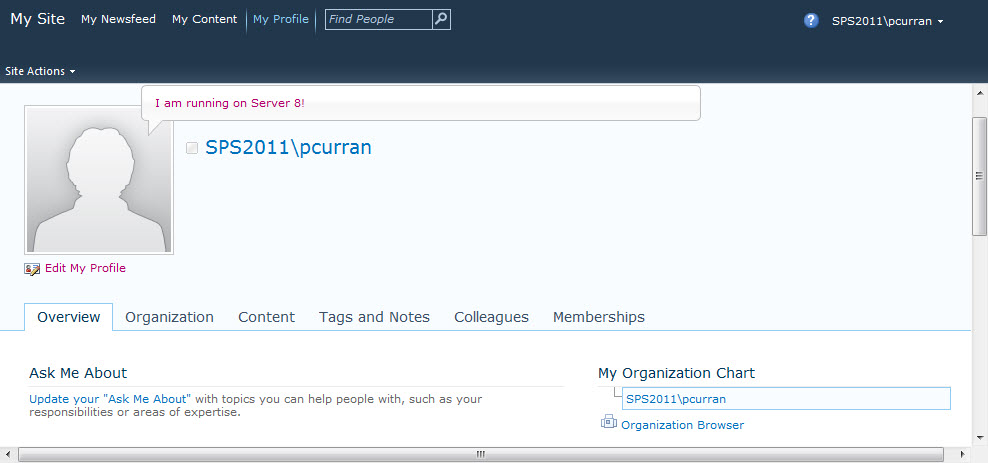
Here is our My Site...

Tuesday, March 6, 2012
Restore SQL DBs Using PowerShell
Of course the next logical thing after getting your backup script working is to create your restore script... I used Donabel Santos's script from http://www.sswug.org/articles/viewarticle.aspx?id=44909 as a reference.
$restoreDir = "c:\shared\Temp\" # last slash very important!

if ((test-path $restoreDir) -eq $false ) # Verify folder exists
  {
     $a = Read-Host("Path Not Found!")
     Exit -1
  }

[System.Reflection.Assembly]::LoadWithPartialName("Microsoft.SqlServer.SMO") | out-null
[System.Reflection.Assembly]::LoadWithPartialName("Microsoft.SqlServer.SmoExtended") | out-null
[Reflection.Assembly]::LoadWithPartialName("Microsoft.SqlServer.ConnectionInfo") | Out-Null
[Reflection.Assembly]::LoadWithPartialName("Microsoft.SqlServer.SmoEnum") | Out-Null

$files = get-childitem $restoreDir -recurse
foreach ($file in $files)
  {
    $backupFile = $restoreDir + $file
    $server = New-Object ("Microsoft.SqlServer.Management.Smo.Server") "(local)"
    $backupDevice = New-Object ("Microsoft.SqlServer.Management.Smo.BackupDeviceItem") ($backupFile, "File")
    $dbRestore = new-object("Microsoft.SqlServer.Management.Smo.Restore")
    $dbRestore.NoRecovery = $false;
    $dbRestore.ReplaceDatabase = $true;
    $dbRestore.Action = "Database"
    $dbRestore.Devices.Add($backupDevice)
    $dbRestoreDetails = $dbRestore.ReadBackupHeader($server)
    "Restoring Database: " + $dbRestoreDetails.Rows[0]["DatabaseName"]
    $dbRestore.Database = $dbRestoreDetails.Rows[0]["DatabaseName"]
    $dbRestore.SqlRestore($server)
  }
Friday, March 2, 2012
Get First and Last Day of Current Month in SQL
I have been spending most of the last couple of day hammering out reports in SSRS. I needed to get information for the current month, but needed to know the first and last dates to set my query. I do not want to run into any kind of Azure Date issues (http://www.wired.com/wiredenterprise/2012/03/azure-leap-year-bug/)
declare @reportDate datetime
declare @lastDate datetime
set @reportDate = GETDATE()
Set @reportDate = DateAdd(Day, 1, @reportDate - Day(@reportDate) + 1) -1
Set @lastDate = DateAdd(Month, 1, @reportDate - Day(@reportDate) + 1) -1
select @reportDate, @lastDate
Update (05/01/2012):
I was not very happy with the above query, so I have updated it... I have also added the functionality to set the time back to midnight...

Update (05/01/2012):
I was not very happy with the above query, so I have updated it... I have also added the functionality to set the time back to midnight...
declare @first datetime
declare @last datetime
set @first = dateadd(day, 1, getdate() - day(getdate()))
set @last = dateadd(day, -1, dateadd(month, 1, @first))
select @first, @last
set @first = DATEADD(dd, DATEDIFF(dd, 0, @first), 0)
set @last = DATEADD(dd, DATEDIFF(dd, 0, @last), 0)
select @first, @last

Thursday, February 16, 2012
Backing Up SQL DBs Using PowerShell
My next project requires that I create several SQL Mirrors, and instead of backing up my databases with SQL, I thought I would try it in PowerShell. The majority of the script is from Edwin Sarmiento's blog http://www.mssqltips.com/sqlservertip/1862/backup-sql-server-databases-with-a-windows-powershell-script/ (Excellent Post)
Update: (03/05/2012)
Added save location verification else create folder.
$bkdir = "\\serverName\Shared\Temp" # Set Backup Path! (optional "C:\Temp")

if ((test-path $bkdir) -eq $false ) # Verify folder else create it...
  {
     [IO.Directory]::CreateDirectory($bkdir)
  }

[System.Reflection.Assembly]::LoadWithPartialName("Microsoft.SqlServer.SMO") | out-null
[System.Reflection.Assembly]::LoadWithPartialName("Microsoft.SqlServer.SmoExtended") | out-null
$s = new-object ("Microsoft.SqlServer.Management.Smo.Server") $instance

$dbs = $s.Databases
foreach ($db in $dbs)
  {
     if(($db.Name -ne "tempdb") -and ($db.Name -ne "master") -and ($db.Name -ne "model") -and ($db.Name -ne "msdb"))
          {
               $dbname = $db.Name
               $dbBackup = new-object ("Microsoft.SqlServer.Management.Smo.Backup")
               $dbBackup.Action = "Database"
               $dbBackup.Database = $dbname
               $dbBackup.Devices.AddDevice($bkdir + "\" + $dbname + ".bak", "File")
               $dbBackup.SqlBackup($s)
               write-host($db.name + " has been backed up.")
          }
  }
If you are saving to a network location, the SQL SA account and the person running the script need to have read/write permissions to the location.Update: (03/05/2012)
Added save location verification else create folder.
Subscribe to:
Posts (Atom)